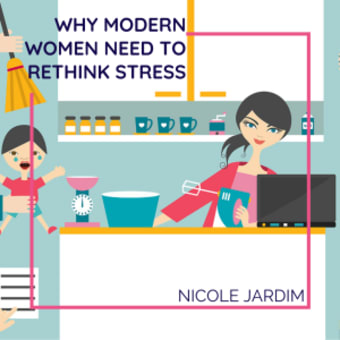
We live in the age of chronic overstimulation. The notifications, the to-do lists that never actually get shorter, the pressure to be productive around the clock — and somewhere underneath all of it, the quiet belief that if you're stressed, you just need to manage it better. More meditation. A better morning routine. Maybe a supplement.
Here's the problem with that framing: it treats stress as a personal organization challenge. Something to optimize around. But for women's hormonal health, stress isn't a scheduling issue — it's a biological emergency signal that, when chronic, rewires your entire endocrine system. And the modern version of stress is fundamentally different from anything our bodies were designed to handle.
Until we understand why that's true, we'll keep reaching for the wrong solutions.
Why Modern Stress Is Different
Your body's stress response system — the HPA (hypothalamic-pituitary-adrenal) axis — evolved to handle acute threats. A predator. A physical emergency. The system fires, cortisol and adrenaline flood the bloodstream, you survive the threat, and then the whole cascade shuts off so you can recover. This is a beautifully designed survival mechanism.
The problem is that our bodies can't tell the difference between a lion and a overflowing inbox. What I mean by that is your nervous system processes a difficult performance review, a sleepless night with a newborn, a financial scare, and an intense spin class all through the same stress pathway. And unlike the lion — which either eats you or doesn't — modern stressors never fully resolve.
This is the critical distinction: our bodies evolved for short bursts of stress followed by genuine recovery. What we're actually living is a state of near-constant low-grade activation with no real off-switch. The alarm is always on. And over time, that wears down every system in your body, starting with the ones your body considers non-essential to immediate survival — like your reproductive system.
The Productivity Identity Trap
There's something specific happening for women that makes this worse. We've been sold a story that our worth is tied to how much we can handle — how many roles we can hold simultaneously, how little we visibly crack under pressure, how efficient we can be with our rest. "Hustle culture" has hit women particularly hard because it layered onto an existing cultural script that women were already running: the one that says taking care of yourself is selfish, saying no is rude, and asking for help is weakness.
Dr. Libby Weaver coined the term "rushing woman's syndrome" to describe exactly this phenomenon — the health consequences that pile up when women live in a state of perpetual busyness and unrelenting stress. What's insidious about it is how normalized it becomes. We stop noticing the stress because we've completely adapted to it. The daily extra-large coffee, the late nights on screens, the never-ending to-do list — these don't feel like stressors anymore. They feel like Tuesday.
But your HPA axis notices. It's been noticing for years.
How HPA Axis Dysfunction Develops in Women
When stress becomes chronic, that elegant diurnal cortisol pattern — rising sharply in the morning to get you up and alert, tapering through the day, dropping low at night so you can sleep — starts to break down. What this looks like in practice depends on how long stress has been unaddressed and individual factors, but there are three common patterns:
- Cortisol remains elevated all the time — wired, anxious, inflamed, struggling to sleep even when exhausted
- Cortisol is low by day, high at night — dragging through the morning, getting a second wind at 10 p.m., lying awake with racing thoughts
- Cortisol is flatlined across the board — the burnout stage, where you feel depleted no matter how much you rest
These aren't three separate conditions. They're often stages on the same continuum. The longer stress goes unaddressed, the more the HPA axis tries to protect itself by downregulating its own response — which is how you go from "wired and tired" to "just exhausted all the time."
What matters for women specifically is that this dysfunction doesn't happen in a vacuum. It plays out against the backdrop of a monthly hormonal cycle that is already asking the HPA axis to do a lot. And women, due to higher baseline estrogen levels, also produce more norepinephrine — the first-responder stress chemical — and metabolize it more slowly. This is part of why women are disproportionately affected by stress-related conditions like depression, PTSD, and anxiety compared to men, and why the symptoms of HPA axis dysfunction so often feel tangled up with cycle problems.
Stress Is the Most Underestimated Period Disruptor
Most women who come to me with cycle issues have never been told that their stress response might be the central driver. They've heard about diet and supplements and sleep, but the idea that chronic stress can stop ovulation, suppress progesterone, and disrupt the entire hormonal cascade — that usually lands as a revelation.
Here's what's actually happening in the body. Cortisol has a dampening effect on GnRH (gonadotropin-releasing hormone), which is the signal from the hypothalamus that tells the pituitary to release FSH and LH — the hormones that drive ovulation. Lower GnRH means lower FSH and LH, which means the ovaries receive less instruction to produce estrogen, progesterone, and testosterone. The entire menstrual cycle slows down or stalls. This can show up as delayed ovulation, irregular cycles, or in more extreme cases, periods that stop altogether — a condition called hypothalamic amenorrhea.
But the interference doesn't stop at the hypothalamus. Cortisol also suppresses the pituitary's ability to respond to GnRH. And even if LH manages to reach the ovaries, high cortisol can make the ovaries resistant to its effects — almost like cortisol blocks the signal at the gate. Read more about how this plays out cycle by cycle in how stress affects your menstrual cycle.
The Cortisol-Progesterone Steal
One of the most important mechanisms to understand is what happens between cortisol and progesterone when stress becomes chronic. You may have heard it called the "pregnenolone steal" — the idea that under chronic stress, your body preferentially converts pregnenolone (a precursor hormone) into cortisol rather than into progesterone and other sex hormones. The body essentially raids its hormone-building materials to keep the stress response funded.
But there's another layer on top of this. Cortisol and progesterone have structurally similar receptors. When cortisol levels are persistently high, cortisol can bind to progesterone receptors — essentially occupying the lock so progesterone can't get in. Think of it like all the gates at an airport being taken by cortisol flights, while the progesterone flights are circling overhead with nowhere to land.
The result is that a woman can have adequate progesterone in her bloodstream on a lab test and still feel every symptom of progesterone deficiency: breast tenderness, PMS mood swings, anxiety and irritability in the week before her period, spotting before menstruation, and the cascade of issues that follow low progesterone. The problem isn't always production — sometimes it's access. And the blocker is cortisol. For a deeper look at the relationship between cortisol and your cycle, see the cortisol connection.
5 Signs Your Stress Response Is Dysregulated
HPA axis dysfunction rarely announces itself clearly. Its symptoms are so commonly accepted as "normal" that most women don't even flag them as problems. Here are five signs your stress response deserves attention:
- You're exhausted but can't wind down at night. Feeling "tired but wired" — dragging through the afternoon, then suddenly alert at 10 p.m. — is a classic sign of dysregulated cortisol that has shifted high in the evening when it should be falling.
- You wake unrefreshed even after a full night's sleep. When the cortisol awakening response is blunted, the body can't generate the morning surge that's supposed to shift you from sleep to alertness. No amount of sleep fixes a broken wake signal.
- Your PMS has gotten progressively worse. The late luteal phase — when progesterone is dropping — is already a low-buffer period for stress. If your PMS has intensified over time, chronic cortisol load is often a central contributor.
- You crave sugar and carbohydrates, especially in the afternoon. Cortisol raises blood glucose, which triggers insulin. The crash that follows creates intense cravings. This cycle is also a driver of blood sugar dysregulation that feeds right back into HPA axis stress.
- Your periods have become irregular or your cycle has lengthened. Delayed ovulation is one of the first ways the body responds to chronic stress. If your cycle is getting longer or harder to predict, your HPA axis is likely suppressing the hormonal cascade needed to trigger ovulation on schedule.
Not sure where your hormones stand?
The free Hormone Health Assessment looks at your full symptom picture — cycle irregularities, energy, mood, digestion, and more — and gives you a personalized breakdown of what your body may be telling you. Five minutes, real clarity.
Take the Free Assessment →The Paradigm Shift: From Managing Stress to Building Resilience
Here's where the reframe happens. The goal isn't to eliminate stress — that's neither realistic nor necessary. The goal is to build your body's capacity to move through stress and recover from it. That's resilience. And it requires a fundamentally different approach than trying to "manage" stress by squeezing a meditation into a packed day.
Managing stress is reactive. You feel overwhelmed, you do a breathing exercise, you feel slightly less overwhelmed. Building resilience is proactive. It means consistently doing the things that restore your nervous system, replenish your metabolic reserve, and expand your window of tolerance — so that when stress hits, you have real resources to draw from rather than running on empty.
This matters because metabolic reserve — the pooled physiological resources your body keeps in stock, including liver detoxification capacity, nutrient stores, immune function, bone mineral density, and mitochondrial health — is depleted by chronic stress. When it's low, your body has less cushion for everything: for healing, for hormonal balance, for recovery from illness. Restoration of metabolic reserve should be the north star, not just symptom management.
Why Rest Is Not a Reward
One of the most damaging beliefs I see in the women I work with is the idea that rest has to be earned. That you can sleep in on Sunday because you worked hard all week. That you can take a bath because you finished your to-do list. Rest-as-reward is deeply embedded in our culture, and it's actively keeping women's nervous systems in a state of dysregulation.
Rest is not a luxury. It is a biological requirement. Sleep is when the body produces growth hormone for tissue repair, when the brain's glymphatic system clears metabolic waste, when emotional processing consolidates, and when cortisol is meant to hit its lowest point so the next morning's awakening response can fire correctly. Most women with HPA axis dysfunction need 7 to 9 hours consistently — and during periods of significant adrenal dysregulation, more.
There's also a subtler version of this: the idea that light-blocking, screen-free evenings, consistent sleep schedules, and protecting your morning cortisol rhythm are indulgences. They aren't. They're literally how your endocrine system calibrates itself each day. Disrupting them — which most modern lifestyles do routinely — is one of the primary drivers of the dysregulated cortisol patterns described above. Worth noting: your morning coffee habit also interacts directly with your cortisol awakening response, and timing matters more than most people realize.
The Nervous System Regulation Toolkit
With that as the foundation, here are the approaches that actually move the needle — not as a checklist to add to your already-full life, but as a new operating framework.
Short-term: Interrupt the stress response in real time
Box breathing is one of the most evidence-backed tools available. Inhale for four counts, hold for four, exhale for four, hold for four. Even three cycles of this shifts the autonomic nervous system toward parasympathetic dominance. It's not a cure — it's a circuit breaker.
Cold water on the face activates the dive reflex and improves vagal tone, which is essentially the measure of your parasympathetic nervous system's reach. A few seconds of cold on your face or a cool shower can genuinely interrupt a cortisol spike.
Eating slowly and without distraction is underrated. How you eat activates either sympathetic (fight-or-flight) or parasympathetic (rest-and-digest) mode. A stressed, rushed meal is a stressor. A calm, slow one signals safety to your nervous system.
Long-term: Rebuild the foundation
Prioritize sleep above almost everything else. No supplement, protocol, or intervention can replicate what consistent, high-quality sleep does for adrenal recovery.
Reduce sugar and alcohol. Both trigger HPA axis activation — sugar through blood glucose spikes and crashes that drive cortisol, alcohol by directly stimulating the stress response and impairing the liver's ability to clear cortisol from the body. These aren't moral judgments; they're physiological facts.
Set real limits on your energy expenditure. This means learning to say no — not as a productivity hack, but because overcommitment is a genuine stressor that activates the same pathways as physical danger. Women are particularly prone to the people-pleasing pattern, and unpacking it is genuinely part of nervous system health.
Get honest about your stress threshold. Your body gives you warning signals before it breaks down: recurring headaches, digestive flares, fatigue, sleep disruption. These aren't inconveniences to push through. They're your HPA axis telling you the load has exceeded capacity. Listen before the system starts failing.
Seek connection. Women's stress response includes what researchers call "tend and befriend" — an oxytocin-mediated pathway toward connection and social support that directly counteracts cortisol. Leaning on your community isn't weakness. It's biology doing exactly what it's designed to do.
Your Body Isn't Broken — It's Protecting You
The women I work with who aren't ovulating regularly, who feel like their cycles have become unpredictable, who are exhausted and wired and hormonally scattered — they almost universally believe their bodies have betrayed them. The reframe I come back to, again and again, is this: your body is working exactly as designed. It has assessed the load you're carrying and concluded that now is not a safe time to support a pregnancy or sustain non-essential functions. That's not a failure. That's a protection mechanism that has kept humans alive for millions of years.
The question isn't what's wrong with you. The question is: what signals of safety can you give your body? Consistent sleep. Nourishing food, eaten calmly. Time outdoors. Real rest. Genuine connection. Movement that energizes rather than depletes. Limits that protect your energy reserves.
These are not luxuries. They are the inputs your nervous system needs to shift out of threat mode and back into a state where hormonal balance — and ovulation, and a healthy cycle — is possible again.
Stress is not something to be managed around. It is something your whole system is responding to. When you start treating it that way, everything changes.