Here is something that shifted everything for me in understanding women's hormone health: your body cannot tell the difference between a looming work deadline and a blood sugar crash at 3 p.m. Both activate the same ancient alarm system — the HPA axis — and both flood your bloodstream with cortisol.
The HPA axis (hypothalamus-pituitary-adrenal axis) is your central stress response highway. It was beautifully designed to handle short, acute threats and then stand down. The problem is that in modern life, the "stand down" signal never comes — because many of the things repeatedly activating it aren't even on our radar as stressors.
This matters enormously for your menstrual cycle. Cortisol and sex hormones compete for the same raw materials. When cortisol is chronically elevated — or chronically dysregulated — it disrupts progesterone production, impairs ovulation, throws off your cycle timing, and can worsen every period symptom you already struggle with. You can read more about that cascade in how stress affects your menstrual cycle.
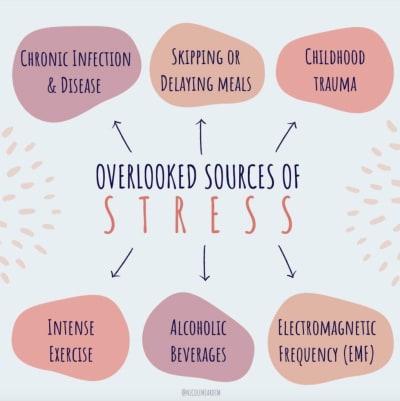
What follows are ten sources of physiological stress that most women never identify — and practical steps you can take to reduce each one.
1. Blood Sugar Instability
Every glucose spike followed by a crash is a physiological stress event. When blood sugar drops too low, too fast, the body perceives it as an emergency: cortisol and adrenaline are released to mobilize stored glucose and get levels back up. Do this multiple times a day — which is easy to do on a diet of refined carbohydrates, skipped meals, or coffee on an empty stomach — and your HPA axis stays chronically activated.
Poor blood sugar control is also listed as one of the primary symptoms of HPA axis dysfunction. The two conditions feed each other in a loop that is very hard to break if you're not addressing both simultaneously. To learn more about this relationship, see how the menstrual cycle affects blood sugar and insulin regulation.
What to do:
- Build every meal around a foundation of protein, fat, fiber, and unrefined carbohydrates together — never carbohydrates alone. A balanced plate prevents the spike-crash pattern that triggers the stress response.
- Eat within one to two hours of waking and aim for meals spaced four to six hours apart. Consistent meal timing is one of the most powerful tools for stabilizing the HPA axis.
2. Over-Exercising and Under-Fueling
High-intensity exercise is a potent cortisol stimulus — by design. The problem arises when the dose is too high and recovery is too low. For women especially, chronic high-intensity training without adequate fuel and rest is one of the most reliable ways to suppress ovulation and lengthen or lose your cycle.
The body interprets excessive exercise load as physical danger. Caloric restriction on top of a heavy training schedule compounds the signal: resources are scarce, and reproduction is not a survival priority. This is sometimes called the female athlete triad, but it doesn't only affect athletes — it shows up in any woman doing daily intense workouts while eating "clean" (read: not enough).
What to do:
- Limit high-intensity training to two to three sessions per week and build in at least one full rest day between intense sessions. Fill the remaining days with genuinely restorative movement — walking, yoga, swimming, or slow strength work.
- Fuel adequately around training. This is non-negotiable. A pre- or post-workout meal or snack that includes protein and carbohydrates helps blunt the cortisol spike and supports recovery.
3. Inflammatory Foods
Processed foods, industrial seed oils (canola, soybean, corn, sunflower), refined sugar, and foods you are individually sensitive to are all internal stressors. They trigger the production of pro-inflammatory cytokines — immune signaling molecules that directly activate the HPA axis. From the body's perspective, gut and systemic inflammation look remarkably similar to an infection or injury. Cortisol is released to dampen the response.
Sugar and alcohol deserve special mention here. Excessive sugar consumption dysregulates the HPA axis through blood sugar fluctuations, and alcohol — despite feeling relaxing — also triggers the HPA axis and stresses the liver, reducing its ability to metabolize and clear cortisol from the body.
What to do:
- Reduce or eliminate refined sugar and ultra-processed foods. Even gradual reduction lowers inflammatory cytokine burden meaningfully over weeks.
- Replace industrial seed oils with stable fats: extra-virgin olive oil for low-heat cooking, avocado oil or ghee for high heat. Add omega-3-rich fatty fish (salmon, sardines, mackerel) two to three times per week, as omega-3s have been shown to reduce elevated cortisol and protect the brain from stress-related inflammation.
4. Toxic Exposure
Endocrine-disrupting chemicals — found in conventional personal care products, cleaning products, plastics (especially BPA), pesticide residues, and synthetic fragrances — impose a real detoxification burden on the body. The liver, which is responsible for clearing both environmental toxins and metabolized hormones including cortisol, can become overburdened.
When the liver's detoxification capacity is taxed, cortisol clearance slows, meaning cortisol stays in circulation longer. Additionally, many endocrine disruptors directly interfere with hormone receptor signaling. The body registers this chemical burden as a form of physiological stress, keeping the HPA axis on low-level alert.
What to do:
- Audit your highest-exposure products first: perfume, body lotion, deodorant, and cleaning sprays. Replace them with fragrance-free or certified clean alternatives. The Environmental Working Group's Skin Deep database is a useful starting point.
- Reduce plastic contact with food and drinks, especially heated plastic. Switch to glass or stainless steel for food storage and water bottles.
5. Poor Sleep
Sleep deprivation is one of the most powerful activators of the HPA axis known to research. Even a single night of poor sleep disrupts the cortisol awakening response — the sharp morning rise in cortisol that sets your circadian rhythm and your energy trajectory for the entire day. When this pattern is disrupted night after night, the downstream effects include poor blood sugar control, immune suppression, mood dysregulation, and worsened period symptoms.
There is also a compounding relationship at work: chronic stress raises cortisol at night, which suppresses melatonin, which makes sleep worse, which raises the next day's cortisol. Breaking this cycle requires intentional sleep hygiene, not just trying harder to fall asleep. For specific product and protocol recommendations, see my favorite tips and products for sleep support.
What to do:
- Protect a consistent bedtime — ideally before 11 p.m. — and aim for seven to nine hours. Consistency in sleep-wake timing is more important than duration alone for stabilizing the cortisol awakening response.
- Eliminate all screens at least one hour before bed and keep your bedroom dark, cool (between 67 and 70°F / 19–21°C), and reserved for sleep only.
Not sure where your stress is coming from?
The free Hormone Health Assessment maps your cycle symptoms to potential root causes — including HPA axis dysregulation — and gives you a personalized starting point in five minutes.
Take the Free Assessment →6. Digital Overstimulation
The nervous system did not evolve to process a continuous stream of notifications, breaking news, social comparison, and ambient outrage. Neurologically, the threat-detection systems in your brain respond to a frightening tweet with measurably similar activation patterns as they would to a physical threat. Your amygdala does not distinguish between a tiger and a scary headline.
Constant digital stimulation keeps the sympathetic nervous system — the "fight or flight" branch — in a state of low-level activation. There is never a true recovery window. Heart rate variability (HRV), a reliable proxy for nervous system resilience, has been shown to decline with heavy social media and screen use, indicating the body is spending more time in sympathetic dominance and less time in the parasympathetic "rest and digest" state where healing, digestion, and hormone production happen.
What to do:
- Set firm time limits on social media and news consumption. Use app timers if needed and schedule two or three specific "check-in" windows per day rather than leaving feeds open continuously.
- Create a morning buffer of at least 30 minutes before looking at your phone, and an evening buffer of at least 60 minutes before bed. These two boundaries alone can meaningfully shift your nervous system baseline.
7. Unresolved Emotional Stress
Perfectionism. Chronic people-pleasing. Suppressed emotions. An inability to say no. These are not personality traits to admire — they are patterns of nervous system activation that, when sustained over months and years, become significant contributors to HPA axis dysregulation.
Women are culturally conditioned toward the "tend and befriend" stress response — taking on more, soothing others, minimizing their own needs. Over time, habitually ignoring the body's "I've had enough" signals depletes the same physiological resources that are needed for hormonal balance and cycle health. The body keeps score of every accommodation you make at your own expense.
What to do:
- Practice identifying your personal stress threshold. Pay attention to early-warning physical signals — fatigue, headaches, digestive upset, irritability — and treat them as information rather than inconvenience. When you notice them, that is the signal to slow down, not to push through.
- Work on saying no as a complete sentence, without over-explaining. Even small boundary-setting practices begin to shift the nervous system out of chronic sympathetic overdrive. Seeking support from a therapist, somatic practitioner, or coach can accelerate this process significantly.
8. Gut Dysbiosis and Intestinal Permeability
The gut and the HPA axis communicate bidirectionally through the gut-brain axis, and an unhealthy gut microbiome is a direct source of physiological stress on the body. When the intestinal lining becomes permeable — a condition commonly called "leaky gut" — bacterial fragments called lipopolysaccharides (LPS) cross into systemic circulation. The immune system reads LPS as a threat and launches an inflammatory response. That inflammatory response activates the HPA axis and elevates cortisol.
Gut dysbiosis also compromises the production of serotonin (roughly 90% of which is made in the gut), depletes key B vitamins needed for adrenal hormone synthesis, and impairs the liver's ability to process and clear estrogen and cortisol. This is one of the reasons gut health is inseparable from hormonal health. See how your period affects your digestive tract for a deeper look at this relationship.
What to do:
- Prioritize prebiotic fiber from vegetables, legumes, and whole grains to feed a diverse microbiome. Diversity of plant foods is one of the strongest predictors of a healthy gut ecosystem.
- Address the most common drivers of intestinal permeability: ultra-processed foods, alcohol, chronic NSAID use, and stress itself. Supporting gut integrity often requires addressing the HPA axis simultaneously — the two systems heal together.
9. Light at Night
Artificial light after sunset — from overhead lights, phones, laptops, and televisions — suppresses melatonin production and disrupts the circadian cortisol rhythm. This is not a minor inconvenience. The relationship between light and cortisol is precise: as daylight decreases, cortisol is supposed to fall and melatonin is supposed to rise. When artificial light tricks the brain into thinking it is still daytime, this transition is delayed or blunted.
The result is elevated cortisol in the evening (when it should be lowest), impaired melatonin production (which is your primary circadian anchor and a powerful antioxidant for ovarian tissue), and shallower, less restorative sleep. This is particularly relevant for cycle health — melatonin plays a direct role in protecting follicles and supporting ovulation quality. Disrupting it disrupts your cycle. To learn more about how light exposure affects fertility and your cycle, see EMFs' effect on your menstrual cycle and fertility.
What to do:
- After sunset, switch to warm, dim lighting. Amber-tinted bulbs, salt lamps, or candlelight are ideal. If you use screens in the evening, enable blue-light filtering software or wear blue-light-blocking glasses.
- Use blackout curtains in your bedroom. Even small amounts of light reaching the eyes during sleep — from streetlights, electronics in standby mode, or a phone screen — can suppress melatonin and fragment sleep architecture.
10. Undereating and Skipping Meals
Caloric restriction is an acute physiological stressor. When the body does not receive enough fuel — whether from deliberate restriction, intermittent fasting taken too far, or simply not having time to eat — it interprets this as a state of food scarcity. The HPA axis responds by releasing cortisol to mobilize stored energy. Not eating enough is, metabolically, an emergency.
This is especially important for women with a history of dieting or disordered eating, as the body can develop a heightened cortisol response to undereating that persists even after normal eating resumes. It is also why extreme "clean eating" that dramatically restricts caloric intake often makes period problems worse rather than better — the body is receiving a clear signal that conditions are not safe enough for reproduction.
For women with a tendency toward low blood sugar or low blood pressure, very low-carbohydrate or extended fasting approaches can be particularly destabilizing. A moderate-fat, moderate-carbohydrate approach with consistent meal timing is often far more therapeutic than aggressive restriction.
What to do:
- Eat breakfast within one to two hours of waking. Starting the day with a protein-forward meal helps establish stable blood sugar for the full day and supports a healthy cortisol awakening response.
- If you are currently in a significant caloric deficit, consider whether it is serving your hormonal health. Gradual, adequate nourishment — not restriction — is the foundation on which every other hormonal intervention rests.
Putting It Together: Your Stress Audit
Reading this list, you may have recognized two, three, or even six of these patterns in your own life. That is not cause for overwhelm — it is useful information. The concept of allostatic load describes the cumulative physiological burden of all stressors combined. No single stressor listed here will break your hormonal health, but four or five operating simultaneously and unaddressed will.
The most effective approach is not to tackle everything at once, but to identify the one or two highest-impact stressors in your specific life and address those first. Blood sugar stability and sleep are usually the highest-leverage entry points — both because they have broad downstream effects on every other item on this list, and because they are actionable within days.
As the body begins to feel safer — well-fed, well-rested, less inflamed, and less bombarded by light and digital stimulation — the HPA axis gradually recalibrates. Cortisol patterns normalize. Progesterone production improves. Ovulation becomes more reliable. The cycle, which is an extraordinarily sensitive barometer of internal safety, begins to reflect that shift.
Your hormones are not broken. They are responding rationally to a body under load. Reduce the load, and the hormones follow. For a broader look at how cortisol weaves through your hormonal picture, see the cortisol connection.