The way women track their cycles has fundamentally changed over the past decade. What used to require a paper chart, a thermometer, and a lot of squinting at temperature columns now has a hardware solution for almost every need — whether you want to confirm ovulation, use natural birth control, understand your hormones in real time, or simply get a better read on your overall health.
I have been following the femtech space closely for years, and I have personally used many of these devices. The landscape keeps evolving — some products that used to be widely recommended are no longer available (more on that below), while genuinely useful new tools have emerged. This guide focuses specifically on wearables and hardware devices, not just apps. If you want a breakdown of the best period tracking apps guide, I cover that separately.
Before we get into the devices, a quick but important note: none of what follows is a lesson in the Fertility Awareness Method (FAM). If you are considering using any device as your primary form of natural birth control, I strongly recommend working with a trained fertility awareness educator alongside using these tools. Technology is a supplement to body literacy, not a replacement for it.
Why Body Literacy Matters — Even With Technology
There is a concept I come back to again and again: your menstrual cycle is your fifth vital sign. Just like heart rate, blood pressure, respiratory rate, and body temperature, your cycle tells your healthcare provider — and you — a tremendous amount about what is going on inside your body. Irregular cycles, short luteal phases, anovulatory cycles, unusual temperature patterns — these are not just inconveniences. They are signals.
The devices in this guide help you capture those signals with far more precision than a period-tracking app that is essentially just counting days. When you combine hardware data with an understanding of what you are looking at, you start building genuine body literacy — the kind that helps you spot hormonal shifts early, optimize your fertility window, confirm that ovulation actually happened, and communicate meaningfully with your doctor about what is going on.
Understanding your body's own patterns also matters if you have concerns like a short luteal phase, PCOS, or irregular cycles — all of which benefit enormously from the more granular data these devices provide.
The Devices I Recommend
These are the devices I currently recommend to clients and in my programs. Each one solves a different problem, so I have included guidance on who each device is best suited for.
Tempdrop
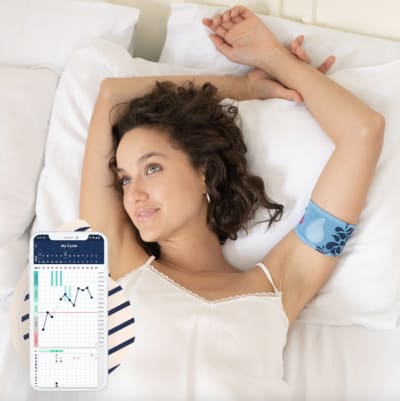
Wearable BBT SensorTempdrop is a small sensor worn on your upper arm in a soft fabric band while you sleep. Throughout the night it takes thousands of micro-temperature readings and uses an algorithm to derive a single reliable basal body temperature (BBT) reading — even if your sleep was fragmented or you woke up at different times. In the morning, you remove it and sync the data wirelessly to the Tempdrop app, where you can view your temperature chart and log additional fertility signs like cervical fluid.
What makes Tempdrop genuinely different from a traditional oral thermometer is the consistency issue. Standard BBT tracking requires you to take your temperature at the same time every morning before getting out of bed — a real obstacle for shift workers, new mothers, people with inconsistent schedules, or anyone who just cannot reliably wake up at the same time. Tempdrop eliminates that constraint entirely.
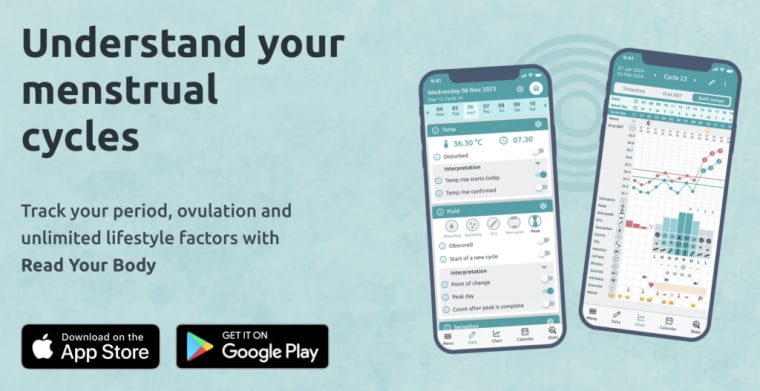
Tempdrop also integrates with the Read Your Body app, which is a privacy-conscious, woman-owned charting app that I like a lot. If you are learning the sympto-thermal method, pairing Tempdrop with Read Your Body is one of the best setups available.
Oura Ring
Continuous Health WearableThe Oura Ring is a smart ring worn on your finger that continuously tracks heart rate variability (HRV), skin temperature, resting heart rate, sleep stages, and activity levels. It synthesizes this data into three daily scores — Sleep, Readiness, and Activity — giving you a real-time picture of how your body is coping with the demands you are placing on it.
For cycle tracking purposes, the Oura Ring's temperature sensors are the relevant feature. Because it measures your temperature continuously overnight, it can detect the subtle temperature shift that follows ovulation and build a picture of your cycle phases over time. The app now includes cycle insights directly within Oura, and the ring can also be paired with the Natural Cycles app (see below) to use your ring data as your BBT input for birth control purposes.
Beyond fertility tracking, the Oura Ring is genuinely useful as a health optimization tool. Seeing your HRV trend down before you feel ill, noticing that certain lifestyle choices consistently tank your readiness score, or tracking how your sleep quality shifts across your cycle are all things the ring does well. It is a meaningful investment, but for women who want biometric health data alongside cycle tracking, it is hard to beat.
Mira Fertility Monitor
Hormone MonitorMira is a two-part system: a small handheld analyzer device and single-use test wands that you dip in urine. Unlike basic ovulation predictor kits that give a simple positive or negative result, Mira uses immunofluorescent lab-grade technology to measure the actual concentration of up to four key fertility hormones in your urine: LH (luteinizing hormone), E3G (estradiol metabolite), PdG (the progesterone metabolite that confirms ovulation occurred), and FSH (follicle stimulating hormone).
This is a fundamentally different approach from BBT-based tracking. You are not inferring what your hormones are doing from temperature changes — you are measuring them directly. For women with PCOS, perimenopause, or cycle irregularities where temperature patterns alone are ambiguous, this level of data is invaluable. Mira's app displays your actual hormone curves across your cycle, learns your personal patterns over time, and gives you a personalized fertile window prediction.
Keep in mind that the wands are a consumable cost — you will use roughly 10–20 per cycle depending on your cycle length and how many hormones you are testing. Mira offers different wand types depending on which hormones you want to track, so you can start with LH and E3G and add PdG testing if you want to confirm ovulation.
Inito Fertility Monitor
Hormone MonitorInito is a small clip-on device that attaches directly to your iPhone and reads specially designed test strips that you have dipped in urine. Like Mira, Inito measures estrogen (E3G), LH, FSH, and PdG — the full hormone picture — and gives you numerical values rather than a simple positive or negative result. Results are available in the app within about 10 minutes.
One thing I want to emphasize about PdG testing, which both Mira and Inito include: most basic ovulation tests only tell you when the LH surge is happening, meaning they predict that ovulation is about to occur. PdG testing goes a step further and confirms that ovulation actually happened by detecting the progesterone metabolite that follows ovulation. For anyone trying to conceive — or for anyone who has been told they ovulate but has reason to question that — this confirmation is extremely meaningful data.
Important note: as of the time of writing, Inito is compatible with iPhone 7 and above but does not support Android devices. Check their current compatibility before purchasing if you are an Android user.
Natural Cycles (with FDA-Cleared Thermometer)
FDA-Cleared Birth Control App + DeviceNatural Cycles holds the distinction of being the first FDA-cleared birth control app in the United States. It works on a relatively straightforward principle: you take your basal body temperature each morning, input it into the app, and the algorithm analyzes your temperature pattern to determine your fertility status for that day — giving you a green (not fertile) or red (fertile) result.
Natural Cycles ships with its own basal thermometer, or it can be used with temperature data from an Oura Ring (as described above) or other connected devices. The ring integration is appealing for people who find oral morning temperatures difficult to take consistently, though I always recommend understanding the underlying temperature patterns rather than relying purely on the green/red output.
The FDA clearance means Natural Cycles has been evaluated for use as birth control under real-world conditions — with a reported 93% typical-use effectiveness rate and 98% with perfect use, which is comparable to hormonal contraceptives when used correctly. That said, I want to be direct: typical-use rates account for human error, and using any temperature-based method as birth control requires consistency and commitment. I always recommend that anyone using FAM-based birth control also understand how to observe cervical fluid and other cycle signs as additional confirmation.
Get your personalized hormonal health protocol
Take the free Hormone Health Assessment — 30 questions about your cycle, symptoms, and lifestyle — and receive a tailored action plan built for your body.
Take the Free Assessment →A Note on Discontinued Products
If you have done research on fertility tracking devices in the past, you may have come across two products that are no longer available: the Kindara Wink thermometer (and the Kindara app, which was discontinued) and the Ava bracelet (Ava's U.S. and European operations shut down in 2023). I used to recommend both of these. I am noting their discontinuation here specifically because outdated blog posts and YouTube videos still recommend them, and I do not want you purchasing something that no longer has support, updates, or a functioning companion app.
The good news is that the current generation of devices — particularly Tempdrop and the Oura Ring — do everything the Ava bracelet was trying to do, with more accurate readings and actively maintained software.
How to Choose the Right Device for Your Goal
The device that is right for you depends almost entirely on what you are trying to accomplish. Here is a quick decision framework:
| Your Goal | Best Device(s) | Notes |
|---|---|---|
| Confirming ovulation occurred | Mira (with PdG wands) or Inito | Both measure PdG, the progesterone metabolite that confirms ovulation happened — not just predicts it. |
| Natural birth control (FAM) | Natural Cycles + Tempdrop or Oura Ring | Pair the FDA-cleared Natural Cycles app with a wearable thermometer for hands-free temperature input. Learn cervical fluid observation alongside. |
| Trying to conceive (TTC) | Mira or Inito + Tempdrop | Hormone monitoring identifies your fertile window precisely; BBT tracking confirms ovulation. Using both gives you the fullest picture. |
| General health optimization | Oura Ring | Best choice if you want continuous biometric data — HRV, sleep, readiness, temperature — beyond just cycle tracking. |
| PCOS or irregular cycles | Mira + Tempdrop | Hormone monitoring catches unpredictable LH surges; Tempdrop handles the inconsistent sleep schedules that often come with the territory. |
| Budget-conscious option | Tempdrop + Read Your Body app | Tempdrop is a one-time purchase with a free basic app tier. Read Your Body is a privacy-focused charting app that integrates directly with Tempdrop. |
Tips for Getting the Most from Any Fertility Tracking Device
Regardless of which device you choose, a few principles will improve the quality of your data and the decisions you make from it.
Give it at least three cycles. Every device needs time to learn your patterns. The first cycle is baseline. The second cycle is when algorithms start personalizing to you. By the third cycle, you have enough data to start drawing meaningful conclusions.
Track more than one parameter when possible. Even if your device does not require it, logging cervical fluid observations alongside temperature or hormone data gives you a much richer picture. The two data streams confirm each other — which is especially reassuring if you are using tracking for birth control purposes.
Consistency matters more than perfection. Wear your Tempdrop every night. Take your urine tests at the same time of day. Gaps in data introduce uncertainty, and consistency is the variable most within your control.
Do not replace a practitioner with a device. These tools are excellent for gathering information, but they are not diagnostic. If you have persistent irregularities, signs of anovulation, or you are having difficulty conceiving, please work with a qualified healthcare provider alongside your device use.
Disclaimer: Nothing in this article should be interpreted as instruction in the Fertility Awareness Method. If you are using or considering using any of these devices as your primary form of birth control, please work with a trained fertility awareness educator. Device effectiveness depends on correct and consistent use.