Feminine wipes are one of those products that seem like a good idea until you look at what's in them. They're heavily marketed toward people who menstruate, positioned as a tool for staying clean, fresh, and confident throughout the day — especially on heavy period days or when you're on the go. They're in every drugstore. They come in floral packaging. They smell pleasant. And they feel like they're doing something good.
The problem is that most conventional feminine wipes are doing something — just not something you want. The ingredients inside that convenient little package can disrupt the exact ecosystem that keeps your vagina healthy. Understanding why requires a quick look at how the vagina actually works.
The Vagina Is Self-Cleaning — It Does Not Need Wipes
Your vagina has a sophisticated built-in cleaning system. Lactobacillus bacteria — primarily Lactobacillus crispatus, L. iners, L. jensenii, and L. gasseri — colonize the vaginal canal and produce lactic acid, hydrogen peroxide, and bacteriocins. This creates a naturally acidic environment (pH 3.8–4.5) that suppresses harmful bacteria, yeast, and pathogens.
The vagina also produces natural discharge, which serves as a continuous self-flushing mechanism — removing dead cells, old blood, and other debris. This is completely normal and healthy. It is not something that needs to be wiped away with a chemical-laden cloth.
The vulva — the external tissue — does benefit from gentle cleansing, particularly during menstruation. But even there, the skin is delicate and highly sensitive. Many of the ingredients found in drugstore feminine wipes are inappropriate for any mucous membrane tissue, let alone the most sensitive area of your body.
What's Actually Inside Conventional Feminine Wipes
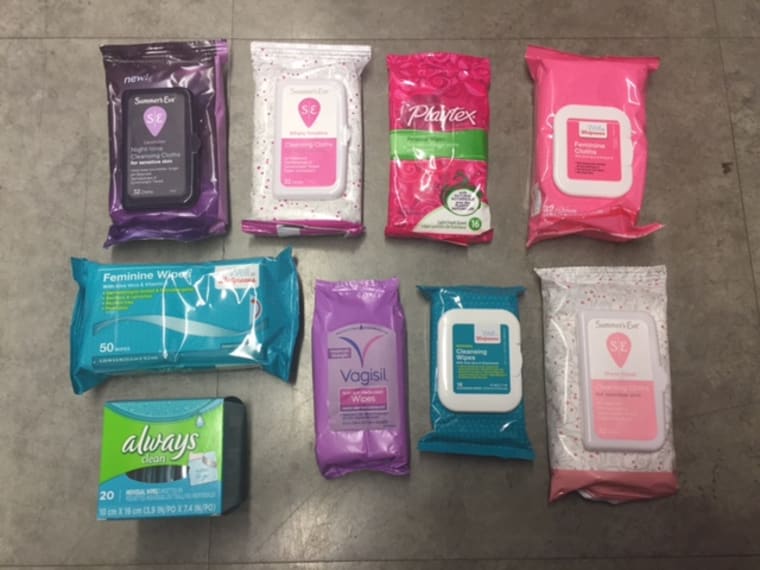
Ingredient transparency in the feminine hygiene category has historically been poor. Manufacturers have not been required to disclose full ingredient lists in the same way food and pharmaceutical companies are, though this is slowly changing. When you do look at the ingredient panels, here is what typically shows up in conventional drugstore wipes:
Common Problem Ingredients to Avoid
- Fragrance / Parfum — A single listed ingredient that can legally contain dozens to hundreds of undisclosed chemical compounds, including phthalates (known endocrine disruptors), synthetic musks, and allergens. The fragrance industry is largely self-regulated. "Unscented" does not always mean fragrance-free — it can mean a masking fragrance was added to neutralize odor.
- Parabens (methylparaben, propylparaben, butylparaben) — Preservatives that mimic estrogen in the body. Parabens have been detected in breast tissue, and their presence in products applied to vaginal and vulvar tissue is of particular concern given the high absorption rate of that tissue.
- Propylene glycol — A penetration enhancer used to help other ingredients absorb more deeply. It is a skin irritant and can increase the permeability of the vaginal lining, essentially helping other problematic ingredients cross the barrier more effectively.
- Methylisothiazolinone (MI) and methylchloroisothiazolinone (MCI) — Preservatives that have been flagged by dermatology organizations as significant contact allergens. MI in particular has been associated with an epidemic of allergic contact dermatitis. These are common in wipes generally, including feminine wipes.
- Sodium lauryl sulfate (SLS) and sodium laureth sulfate (SLES) — Surfactants (cleansing agents) that are highly effective at stripping protective oils from skin. In vaginal and vulvar tissue, SLS can damage the mucosal barrier and disrupt the protective environment the lactobacillus community depends on.
- Synthetic dyes — Added for color with no functional benefit. Many synthetic dyes are potential allergens and have not been adequately tested for safety on vaginal tissue.
- Alcohol — Isopropyl alcohol or ethanol, often added for its antimicrobial properties, but harshly drying on vaginal and vulvar tissue. Alcohol is indiscriminate — it kills the beneficial lactobacillus along with pathogens.
- Benzalkonium chloride — An antimicrobial preservative that has been shown to be toxic to lactobacillus species and is a common cause of vulvar contact dermatitis.
How These Ingredients Affect Your Vaginal Health
These are not abstract concerns. The vaginal microbiome is a genuinely fragile ecosystem, and the consequences of disrupting it are well-documented and frequently experienced by the people I work with.
Killing the lactobacillus community
When you apply a wipe containing alcohol, surfactants, antimicrobial preservatives, or highly alkaline ingredients to your vulva regularly, you are creating conditions that suppress Lactobacillus species. These bacteria are not incidental — they are the foundation of vaginal health. A reduction in lactobacillus diversity and abundance raises vaginal pH, which in turn creates an environment where bacterial vaginosis (BV) pathogens (Gardnerella vaginalis, Prevotella, Mobiluncus) and Candida species thrive.
If you are someone who gets recurrent BV or yeast infections and you use feminine wipes regularly, the wipes are a very plausible contributing factor — and one that is often completely overlooked by conventional providers.
pH disruption
Healthy vaginal pH sits between 3.8 and 4.5. Many conventional wipes are formulated at a pH much higher than this, or contain ingredients that buffer the vaginal environment toward a higher pH. Labels claiming "pH-balanced" are not independently verified — there is no regulatory body confirming those claims before they go on the shelf. A wipe marketed as pH-balanced can still contain fragrance and preservatives that disrupt microbial pH indirectly.
Contact dermatitis and chronic irritation
Vulvar contact dermatitis — inflammation caused by an allergic or irritant reaction to a topical substance — is more common than most people realize, and feminine hygiene products are among the leading causes. The itching, redness, burning, and discharge that result from contact dermatitis are frequently misidentified as yeast infections, leading to repeated courses of antifungal treatment that provide temporary relief but don't address the root cause. If you are treating what seems like a recurring yeast infection without resolution, a contact allergen in your hygiene routine is worth investigating.
Xenoestrogens and hormonal impact
Several ingredients in conventional feminine wipes — parabens, phthalates (often hidden in fragrance), and certain synthetic preservatives — are classified as xenoestrogens: compounds that bind to or mimic estrogen receptors in the body. Chronic low-level exposure through a frequently applied product is not equivalent to a single dose, and cumulative exposure to xenoestrogens over years of use is a legitimate concern for hormonal balance. The vulvar and vaginal tissues are especially relevant here because their high vascularity and thin mucosal lining facilitate direct absorption into the bloodstream.
When Wipes Might Make Sense — and What to Look For
I am not here to tell you that wipes have no place in anyone's life. During travel, on heavy flow days away from home, or in situations where a shower isn't accessible, a wipe is genuinely useful. The issue is not the format — it's the ingredients. If you want to use wipes occasionally, here is what to look for:
- Water-only or saline-based — The simplest formulas are often the safest. A wipe that is essentially a moistened cloth with no added actives is far less likely to cause harm.
- Organic cotton substrate — Conventional cotton is among the most heavily pesticide-treated crops. The cloth itself matters, not just the solution.
- Fragrance-free — No fragrance, no parfum, no "natural fragrance." Verify this in the ingredient list, not just from the label claim.
- Free from parabens, alcohol, dyes, methylisothiazolinone, and benzalkonium chloride — These are the specific ingredients with the strongest track record of causing harm to the vaginal environment.
- Short ingredient list — The fewer ingredients, the fewer potential irritants. If you cannot recognize most of what's listed, that is a signal worth heeding.
Brands that have formulated toward these standards include Rael, The Honey Pot (select fragrance-free products), Natracare, Organyc, and Lunette. These are not endorsements and formulations can change — always read the current ingredient list before purchasing, as manufacturers update formulas without prominently announcing it.
The external-only rule, without exception: No wipe — regardless of how clean the formulation — should ever be used internally. Inside the vaginal canal, even the gentlest ingredients can disrupt the delicate microbiome. Wipes are for the external vulvar area only. This applies to all wipes marketed as "intimate," "feminine," or otherwise.
Better Alternatives for Day-to-Day Care
The most effective and safest option for vulvar hygiene is also the simplest: warm water. Rinsing the external vulvar area with warm water during your shower is sufficient for most people on most days. The vagina, as discussed, handles its own cleaning. The vulva does not require soap, and certainly does not require fragrance or antimicrobials.
If you prefer using something beyond water, here are options I consider reasonable:
Warm water and a reusable washcloth
A soft, dedicated washcloth used only for this purpose and washed regularly is a genuinely good option. It's gentle, produces no waste, and costs nothing beyond the initial purchase. Keep it separate from other washcloths to avoid cross-contamination.
pH-balanced intimate wash (external only)
If you prefer a cleanser, look for an intimate wash formulated at pH 3.5–4.5, free from fragrance, SLS, and parabens, and intended for external use only. Use it on the external vulva — not inside the vaginal opening. Again, the vagina does not need to be washed; cleansing should be limited to external tissue.
On-the-go: a squeeze bottle of water
If you're someone who travels frequently or needs a portable hygiene option, a small travel squeeze bottle filled with water is genuinely effective. It sounds too simple, but water is the safest choice and it works. This is preferable to any wipe on particularly sensitive days or if you have a history of contact dermatitis or recurrent infections.
The Microbiome Connection: Why This Matters Beyond Discomfort
The consequences of a disrupted vaginal microbiome extend beyond the immediate discomfort of an infection. A healthy Lactobacillus-dominant vaginal environment protects against sexually transmitted infections, plays a role in fertility outcomes, and influences the immune environment of the reproductive tract. Research into the vaginal microbiome has accelerated significantly in recent years, and the picture that is emerging is one in which chronic low-grade dysbiosis — not full-blown BV, but a persistent shift away from a healthy Lactobacillus-dominant state — has downstream effects on reproductive and hormonal health.
This means that the cumulative impact of years of exposure to microbiome-disrupting hygiene products is not a trivial concern. It is the kind of slow, incremental shift that rarely gets attributed to its actual cause because the timeline is too diffuse and the connection too non-obvious. But when clients I work with remove conventional feminine hygiene products from their routines as part of a broader approach, the improvements in chronic vaginal symptoms — recurrent BV, recurrent yeast, persistent irritation, abnormal discharge — are frequently striking.
If you want to learn more about how to assess and support your vaginal microbiome directly, see my article on vaginal microbiome testing and what the results can tell you.
Get a personalized hormonal health protocol
Take the free Hormone Health Assessment — 30 questions about your cycle, symptoms, and lifestyle — and receive a tailored action plan built for your body.
Take the Free Assessment →